Tuesday, December 19, 2023

PianoDisc Player System Installation and Repair | Piano Restoration

 New PianoDisc Prodigy Grand Player System

PianoDisc Prodigy is the culmination of everything PianoDisc strives for—the absolute best piano player system, powered by cutting-edge technology, with a simple, streamlined experience just for you. All in an invisible package on your piano. Enjoy listening to your most popular artists, playing your piano, hearing their band, hearing the real artists sing the song, while also watching the video of the performance. In addition, live streaming entertainment is available 24/7 to play right on your piano in your home without streaming subscriptions. Prodigy combines PianoDisc’s innovative SilentDrive HD technology and iQ’s High Resolution software with over 1,024 levels of expression into one box. 
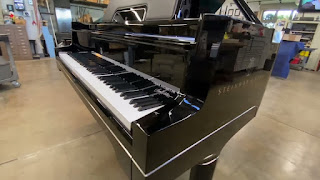
No wires, no fuss. With Bluetooth, Analog, TOSLINK, MIDI 5-pin DIN, USB and Bluetooth MIDI, Prodigy gives you more ways to connect to your piano than ever before. The Android and iOS iQ Player App makes available thousands of songs in every genre, and gives you more precise control of playback and better performance than ever before. Create unlimited playlists to play whatever artists in whatever order you wish to listen. All of your PianoDisc music is stored on your device, this means instant music with no streaming or download delays. You can also have music on multiple devices to please everyone’s taste. And since all of your music is available from PianoDisc’s online delivery service, if you ever change iOS devices, a PianoDisc customer service representative will be happy to assist you in downloading your existing music to the new device. After Prodigy is installed it is completely invisible—no distracting boxes, wires, or cables that take away from the beauty of your piano. It’s just you and your enjoyment of the entertainment.

Get More Info : Polyester Piano finish repair

Websites : https://www.nypianoworks.com/

Contact Us : Piano Tuner Upstate New York

Monday, December 11, 2023

Grand Piano Regulation | Historical Keyboards

The action of a grand piano is truly a mechanical marvel. Even though it was perfected before the turn of the last century, its remarkable design is still in use today. Although the operation of a grand piano may seem simple from the outside, inside it is in fact highly complex. Just as an accomplished athlete can make a difficult skill “look easy,” the efficiency of the grand piano action makes a very complicated set of motions seem simple. In fact, it is anything but simple.

When a note on your piano is played, the energy from your finger instantly puts a carefully balanced system of levers and springs into motion. Five pivot points simultaneously swing the combination of parts into action. Felt cushions at all contact points prevent action noise from intruding upon the music produced.

The primary reason that the action of a grand piano goes out of regulation is that the felt parts (over two dozen per note) which are so important to its functioning become worn and compressed with age and use. As this compression occurs, adjustments to the contact points which were made when the piano was new no longer are accurate. As this happens, a gradual loss of performance occurs. Lost motion in the action prevents maximum power from being transmitted from the keys to the strings when forte is called for. Early release of the hammers causes misfiring notes when subtle pianissimos are attempted. Double-striking notes become an annoyance. Although the change occurs over time, at some point it starts to become obvious that the piano is not at peak performance. Pivot Points

Regulating your piano will go a long way towards seeing to it that whoever sits down to play will find it a truly satisfying experience. The piano will perform with more precision and evenness so that the musician may lose him or herself in the music. (How nice it would be to have a guest say, “Oh, your piano plays beautifully. Would you mind if I sit here for awhile and enjoy it?”)

If other repairs are needed, is it necessary to make them first?

It’s highly recommended that all important repair work involving the action of your piano be completed before the instrument is regulated. That way, the work will result in the maximum benefit.

Hammers in a grand piano

One might compare regulating a piano to painting an automobile. If the body of a car had not been cared for in years and had taken a real beating it would make no sense whatsoever to take expensive paint and spray it over rust and dents without preparing the surface beforehand. All important body work would need to be done before the paint would be applied, otherwise both the labor and the paint would be pretty much wasted.

In a similar way, if a piano has not been maintained on a regular basis, it should be looked over carefully to determine what repairs are needed in preparation for regulating. Hammers may be badly worn and in need of replacement (see photo at right) or shaping. Action parts may need repairing or alignment. Key bushings might need to be replaced or resized. Any repair which would have an effect on the regulation process should be accomplished first, before the time-consuming job of setting adjustments is made. Otherwise, a great deal of backtracking might be necessary down the road when adjustments which were made once are thrown off by new parts or repairs.

Get More Info : Piano Humidity Control

Websites : https://www.newyorkpianoworks.com/

Contact Us : Piano Finish Repair

Sunday, December 3, 2023

Piano Restoration | Piano Regulation And Voicing

Piano restoration involves the careful rejuvenation of an instrument, addressing issues such as worn-out parts, damaged soundboards, and deteriorated finishes. This meticulous process requires a blend of craftsmanship, technical expertise, and a deep appreciation for the instrument's history.

Initial Assessment:

The restoration journey begins with a thorough assessment of the piano's condition. A skilled technician evaluates the structural integrity, examines the soundboard, inspects the action mechanism, and assesses the overall wear and tear. This step is crucial in determining the scope of the restoration project.

Structural Repairs:

a. Soundboard Restoration: The soundboard is a vital component that influences the piano's tonal quality. Restoration may involve repairing cracks, reinforcing the soundboard, or even replacing it if necessary.

b. Action Overhaul: The action mechanism, comprising keys, hammers, and other intricate parts, is meticulously inspected. Worn-out components are replaced, and adjustments are made to ensure a responsive and consistent touch.

c. String Replacement: Over time, piano strings can lose their vibrancy and tone. Restorers carefully replace old strings with new ones to enhance the instrument's sound quality.

Cosmetic Refinishing:

a. Cabinet Restoration: The piano's external appearance is just as important as its internal components. Skilled craftsmen work to restore the cabinet, addressing scratches, dents, and worn finishes. This step can involve traditional refinishing techniques or maintaining the instrument's vintage aesthetic.

b. Keytop Replacement: Ivory keytops, once a standard feature, may need replacement due to wear or damage. Restorers use high-quality materials to replicate the original look and feel.

Voicing and Tuning:

Voicing involves shaping the hammers to achieve the desired tone, while tuning ensures that the piano is in perfect pitch. These final adjustments are crucial for bringing the instrument to its full melodic potential.

Preserving History:

Piano restoration is not just about fixing wear and tear; it's about preserving the instrument's history and legacy. Restorers often take care to maintain the unique characteristics that make each piano a piece of living history.

Piano restoration is a labor of love that transforms aging instruments into timeless masterpieces. Whether it's a family heirloom or a vintage find, the restoration process not only revives the piano's original beauty but also ensures that its harmonious melodies continue to resonate for generations to come.

Get More Info : Piano Restoration

Websites : https://www.newyorkpianoworks.com/

Contact Us : Piano Tuner Upstate New York

Sunday, November 26, 2023

Piano Tuning | Piano Tuning And Repair Service

Tuning a piano is the process of adjusting the tension of its strings, thereby altering their pitch, or frequency of vibration, by slightly turning the tuning pins to which they’re attached, so that each string sounds pleasingly in harmony with every other string. This harmony is achieved by tuning the piano according to certain known acoustical laws and aesthetic rules and customs.

How Is a Piano Tuned? Is It Difficult?

To the uninitiated, tuning a piano may seem a simple, straightforward procedure, but it isn’t. The process is complicated by the sheer number of strings and tuning pins (more than 200 of each, the exact number varying with the model), by the high tension under which the strings are stretched, by the tightness with which the tuning pins are anchored in the pinblock, and by the friction points over which the taut strings must slide as they’re being tuned. All of these factors are obstacles not only to tuning, but also to creating a tuning that will be stable for a reasonable length of time, given the piano’s use and environment.

Tuning is also made more difficult by the design element of modern pianos known as loop stringing. In loop stringing, each length of steel music wire in the treble actually forms two strings, which are separated by a sharp bend in the wire where the strings are anchored to the piano’s cast-iron frame. Sometimes these two strings sound the same note and are tuned to the same pitch. Other times, they are parts of adjacent notes, with one half of the wire tuned a half step higher or lower than the other half, the two halves necessarily held at distinctly different tensions. Because all parts of a single wire have a tendency to seek the same tension, loop stringing is a more challenging environment in which to learn how to create a stable tuning.

In addition to physical obstacles, there are acoustical obstacles to tuning. A paradox common to all fixed-pitch instruments, first discovered by the ancient Greeks, is that it’s impossible for all the intervals — thirds, fourths, fifths, sixths, etc. — within a perfect octave to themselves be perfect. This problem is dealt with by slightly expanding or contracting — tempering — each of these intervals so that, together, they will add up to a perfect octave. The tuner creates a temperament — a single octave of 13 notes at the center of the keyboard in which every note is tuned in its correctly tempered relationships to all other notes in that octave — and then copies those relationships to all remaining sections of the keyboard by tuning each note to be a perfect octave (or octaves) above or below the corresponding note in the temperament octave.

Get More Info : Piano Tuning And Repair Service

Websites : https://www.newyorkpianoworks.com/

Contact Us : Piano Tuner Upstate New York

Monday, November 20, 2023

Regulation/Action Work, Voicing, Rebuilding / Restoration | Piano Restoration


Pianos age like all machines, and their parts wear out over time. While a quality piano will outlast most other things in your life, at some point the strings will cease to be responsive and the action parts will have irreparable wear. At this point, a partial or full rebuilding is required. New York Piano Works will come to your house and provide you with a written estimate for this complicated procedure.

Restoration is bringing the piano back to its original condition by reconditioning original parts and using historically accurate replacements where applicable. It is generally more expensive than rebuilding but keeps the piano true to its origins.

Get know to about the piano restoration CLICK HERE : Piano Restoration Upstate New York 

Thursday, November 16, 2023

Piano Master Technician

The world of music is a symphony of craftsmanship, and at its heart lies the piano – a timeless instrument that has captivated audiences for centuries. Behind the scenes, a key player in maintaining the magic of these grand instruments is the piano master technician. In this blog post, we'll delve into the fascinating realm of piano craftsmanship and explore the skills and artistry of these unsung heroes who ensure that every note resonates with perfection.

The Craftsmanship Behind the Keys:

Explore the intricate construction of a piano and the various components that contribute to its unique sound.

Discuss the historical evolution of piano craftsmanship and how it has shaped the instruments we know today.

The Role of a Piano Master Technician:

Uncover the responsibilities of a piano master technician, from tuning and regulation to voicing and restoration.

Highlight the importance of regular maintenance in preserving the longevity and performance of a piano.

Tuning Mastery:

Dive into the art of piano tuning, exploring the delicate balance required to achieve the perfect pitch.

Discuss the impact of environmental factors on tuning and how technicians use their expertise to overcome challenges.

Regulation and Precision:

Examine the role of regulation in ensuring the responsiveness and consistency of a piano's touch.

Showcase the precision required in adjusting the piano's action mechanism to meet the exacting standards of musicians.

Get More Info : Piano Master Technician

Websites : https://www.newyorkpianoworks.com/

Contact Us : PianoDisc Installation


Monday, November 6, 2023

Basics of Piano Care | Piano Master Technician

Owning a piano is a significant investment, and taking proper care of it is essential to ensure that it retains its beauty, functionality, and value over the years. Whether you're a seasoned pianist or just starting, understanding the basics of piano care is crucial. In this blog post, we'll explore the fundamental steps to keep your piano in optimal condition.

Caring for your piano is not just about maintaining its beauty; it's about preserving its musicality and longevity. By following these basic piano care guidelines, you can ensure that your piano remains a cherished part of your life for generations to come. If you're ever in doubt or encounter issues, don't hesitate to consult a qualified piano technician for professional advice and maintenance.

Get More Info : PianoDisc Repair

Websites : https://www.newyorkpianoworks.com/

Contact Us : Piano Tuner Upstate New York

Grand Piano Regulation

For pianists, a grand piano is a majestic instrument capable of expressing a vast array of emotions. But that expressiveness hinges on one c...