Showing posts with label Piano Master Technician. Show all posts

Thursday, February 29, 2024

Piano Rebuilding Albany | Rebuilding / Restoration

Pianos age like all machines, and their parts wear out over time. While a quality piano will outlast most other things in your life, at some point the strings will cease to be responsive and the action parts will have irreparable wear. At this point, a partial or full rebuilding is required. New York Piano Works will come to your house and provide you with a written estimate for this complicated procedure.

Restoration is bringing the piano back to its original condition by reconditioning original parts and using historically accurate replacements where applicable. It is generally more expensive than rebuilding but keeps the piano true to its origins. 

Get More Info : Grand Piano Regulation

Website : https://www.nypianoworks.com/

Contact Us : Piano Tuner Berkshires

Tuesday, January 30, 2024

Humidity Control for your Piano | Historical Keyboards

Many people are not aware that humidity can have a profound effect on the tuning and performance of your piano. Humidity is a measure of how much water vapor is in the air, relative to the maximum amount of water vapor it can hold (that’s why it’s called relative humidity!).  Your piano is subject to wide swings in humidity. This is particularly true in the Hudson Valley, where the majority of our clients live. In the summer, humidity levels can go as high as 100%, while in the winter, your heating system can drop the relative humidity in your home into the single digits.

What does this mean for your piano? When the humidity is high, the soundboard and bridges absorb moisture and swell, increasing the tension of the strings and forcing the piano sharp. When the humidity is low, the opposite happens - the soundboard and bridges release moisture and shrink, reducing the downward pressure of the strings and forcing the piano flat. This is why almost all piano manufacturers - and your piano technician - recommend that your piano is tuned twice a year. In addition to forcing your piano out of tune, increased humidity affects the action parts, swelling the wood and increasing friction, which can make your action respond sluggishly (a major cause of “sticking” keys).

How can you mitigate the effects of humidity on your piano? There are several options. The absolute best solution is to have your whole house humidity controlled. This involves either attaching a humidifier to your HVAC system or installing a separate humidifier/dehumidifier system in your home. While this is the best solution, it can be very expensive to install and maintain, and is usually cost prohibitive. 

Get More Info : Piano Restoration

Website : https://www.nypianoworks.com/

Contact Us : Piano Tuner Upstate New York

Monday, June 6, 2022

How do I decide if major repairs of piano are appropriate?

Not all pianos are worth the expense of reconditioning or rebuilding. In consultation with your piano technician, you should consider the following factors:

  • The overall condition of the piano. Can it really be restored to its original condition or is it deteriorated beyond repair? Pianos subjected to severe fire, flood, or moving damage may not be repairable.
  • The quality, size, and type of the piano. Low priced, small pianos of poor design have limited potential. If the rebuilt piano would not be capable of meeting your performance needs, it would be better to replace it with one of better design.
  • The cost of repairs versus replacement. Major repairs may exceed the value of small low-quality pianos. However, most large high-quality instruments can be rebuilt for one-half to two-thirds of the cost of a comparable new piano, making rebuilding a cost-effective option for fine pianos.
  • Sentimental value. Personal attachment or historical value may justify investing in major repairs rather than replacement.
Get detail info:

Tuesday, May 24, 2022

Dusting Your Piano | Piano Master Technician

Dust is very abrasive and can scratch the finish if wiped off with a dry cloth. To avoid scratching, dust the piano lightly with a feather duster. Alternatively, wipe lightly with a soft damp cloth to pick up the dust, followed immediately with a dry cloth. The cloths should be soft cotton such as flannel because coarse or synthetic fabrics can scratch some finishes. Wring out the damp cloth thoroughly so it leaves no visible moisture on the surface.

To avoid creating swirl marks, always wipe with long straight strokes rather than circular motions. Wipe with the grain for natural wood finishes, or in the direction of the existing sheen pattern for solid-color satin finishes.

Because some exposed parts inside your piano are fragile, it's best to let your technician clean these areas.

Get detail info: 

Piano Repair

Piano Finish Repair

Thursday, May 19, 2022

Should you polish your piano or not?

 Before using polish on your piano, be sure it is actually necessary and beneficial. In general, most manufacturers recommend using against polishes because of the potential for damage to the finish and contamination of other parts of the instrument.


Common household products such as "lemon oil" or inexpensive "furniture polish" should be avoided. Despite the labels' claims that they "protect" the finish or "feed" the wood, they offer no protection from scratching and can actually soften the finish if over-used. Worse, they often contain silicones and oils that contaminate the wood, complicating future refinishing or repairs. Silicone is especially dangerous because of its tendency to spread within the piano, sometimes causing extensive internal damage. Avoid aerosol products altogether since the over-spray can contaminate piano strings, tuning pins, and action parts.

An appropriate polish can help to restore luster to a dulled finish or reduce the tendency of some finishes to show fingerprints. However, it should be applied sparingly and infrequently, and all excess should be wiped clean with a soft dry cloth so no visible film remains. To prevent scratching, always dust before polishing. Specific recommendations follow.

Get detail info:

Monday, May 9, 2022

Does your piano need voicing?

 Your piano may benefit from voicing if:


  • Your piano sounds different than when you purchased it.
  • You don't like the sound even after it has been tuned.
  • The tone varies radically from note to note.
  • You cannot achieve a range of tones (mellow to bright) at different volumes.
  • The piano has lost its ability to play softly.

Before deciding if a new piano needs voicing, make sure it is well-tuned and well-regulated. Then, play a wide variety of music on it. Most voicing procedures are long-lasting, so give yourself some time to explore the sound of a new instrument before deciding to change it.

How often voicing is needed depends upon the piano's usage and its intended audience. Pianos in concert halls and recording studios often receive minor refinement of the voicing before each performance. A home piano may need some initial voicing to customize it to the owner's taste, then once every one to five years to maintain its tone.

Your piano and your musical needs are unique -- your own schedule for periodic voicing is a matter for you and your technician to decide. To find out how voicing might improve the tone of your piano, ask for a demonstration on one or two notes.


Also Visit:

Thursday, April 28, 2022

What is a Good Tone in Piano?

 The tone varies, even among pianos of the same make and model. No matter what its size or cost, any good piano should provide a wide range of tones, from soft and sweet to loud and bright. The tone should be even from the lowest to the highest notes. Most of all, it should sound musical.


What does the perfect piano tone sound like? There is no single answer because everyone's taste varies. Also, certain tonal characteristics are more suited to specific styles of music. A bright, lively tone might be best for jazz, whereas you might prefer a rich and dark sound for Beethoven's music. There are many different sizes and models of piano available in the marketplace; you chose your piano because it sounded good to you.

But a piano's tone changes with use. As the hammers wear and compact, the tone often becomes too bright and harsh, robbing the pianist of the ability to produce a sweet sound. As parts wear, the regulation (adjustment of the mechanical parts that transmit motion from the fingers to the hammers) becomes uneven, and the pianist loses control over volume and tone. This is most noticeable in quiet playing. A delicate pianissimo passage becomes very difficult or impossible to play, and some keys may not sound at all if played very lightly.

Aging of the piano's strings and structure also can diminish its tone.

Other factors that affect the sound you hear from your piano are: 

  • ROOM ACOUSTICS -- Hard shiny surfaces such as windows and bare floors reflect high frequencies, making a piano sound bright and loud. High ceilings or large adjoining rooms add resonance. Rugs and upholstered furniture soften the tone and add warmth.
  • THE LID -- Both grands and verticals sound louder and brighter if the lid is opened.
  • YOU -- Your ears are sensitive and will perceive sound differently if you have spent all day in a quiet office or at a loud construction site.

Get detail info:

Thursday, April 7, 2022

How will humidity control benefit my piano?

While not eliminating the need for regular piano maintenance, humidity control will allow more stable tunings by reducing the radical pitch changes your piano may experience through the seasons. When your piano stays closer to its correct pitch level of A440 (440 cycles per second), your technician does not have to perform a large pitch raising or lowering procedure prior to fine-tuning. Thus, a balance of forces is maintained between the strings and the frame of the piano, allowing more accurate and stable tunings to be done.

In addition, a stable environment will help to preserve your piano through the years. Wood parts, glue joints, metal parts, and your piano's finish will all last longer if not subjected to excessive humidity swings. Maintaining the correct environment will preserve your piano investment for a lifetime of enjoyment.

Get detail info: Piano Rebuilding Hudson Valley

Also Visit: 

Piano Regulation And Voicing

Piano Repair

Tuesday, March 29, 2022

What can be done to minimize humidity problems in piano?

Keeping the humidity level around your piano as constant as possible will help it stay in tune longer as well as slow such damage as soundboard cracks, loose tuning pins, and glue joint failures. The first and simplest action you can take is to position your piano away from areas where it would be exposed to extremes of temperature and humidity such as heating and cooling vents, stoves, doors, and windows. Direct sunlight is especially damaging. If your home is not well insulated, an interior wall is preferable to an outside wall. 

Controlling the humidity within the home is another step you can take to preserve your instrument. Use of a room humidifier during dry seasons will help somewhat. However, too much moisture added to a room during winter months can cause condensation to form on cold surfaces such as windows, eventually causing mildew, rot, and in extreme cases, damage to the building structure. During the humid season, de-humidification is needed. If your humid season is winter, keeping the home evenly heated will help. However, humid summer situations require much more elaborate de-humidification systems. Unfortunately, it is seldom possible to adequately control the relative humidity of a piano by controlling the room environment alone.

A very practical and effective answer to humidity problems is to have a humidity control system installed in the piano itself. These systems consist of three parts: a humidifier for adding moisture to the air, a dehumidifier for eliminating excess moisture, and a humidistat or control unit which senses the RH of the air within the piano and activates the system to add or remove moisture as needed. These systems are designed to maintain the RH of the air within the piano at the ideal level of 42%. The components are installed out of sight, inside the case of a vertical piano or under the soundboard of a grand. They are easy to maintain and can be installed by your piano technician.

Get detail info: Piano Rebuilding Upstate New York

Also Visit: Piano Regulation And Voicing

Tuesday, March 22, 2022

Piano Tuning And Repair Service


  • Tuning $175 - A standard tuning is for those pianos that have been tuned in the past 6 months to a year. It involves manipulating the tuning pins to bring all 230 strings to their proper and harmonious pitch. We use a combination of aural and electronic tuning to ensure your piano sounds great! We also tighten the plate bolts, check for problems, and tighten the bench.
  • Pitch Adjustment $95 - If we haven’t seen your piano in a while, it may need one or more Pitch Adjustments to bring the strings up to a tension where fine tuning is possible without stressing the piano.
  • Repairs (Prices Vary) - Do you have a stuck key or broken string(s)? We can help! Our technicians are well trained in all manner of repairs, from a simple stuck key to major action work.


Also Visit: Piano Tuner Albany

Tuesday, November 9, 2021

Action Regulation | Piano Regulation

What is regulation and how does it affect my piano's performance?


Regulation is the adjustment of the mechanical aspects of the pianos to compensate for the effects of wear, the compacting and settling of cloth, felt, and buckskin, as well as dimensional changes in wood and wool parts due to changes in humidity. 

The three systems involved in regulation are the action, trapwork, and damper system. The action is the mechanical part of the piano that transfers the motion of the fingers on the keys to the hammers that strike the strings. It is comprised of over 9,000 parts which require adjustment to critical tolerances to be able to respond to a pianist's every command. The trapwork is the assemblage of levers, dowels, and springs that connects the pedals to the action affecting sustain and dynamics. The damper system is the mechanical part of the piano that stops the vibration of the string when you release the key and is controlled by the key and pedal systems.

Read More About Click Here :  Piano Regulation

Piano Restoration Upstate New York 

Wednesday, February 17, 2021

Humidity Control for your Piano

 Many people are not aware that humidity can have a profound effect on the tuning and performance of your piano. Humidity is a measure of how much water vapor is in the air, relative to the maximum amount of water vapor it can hold (that’s why it’s called relative humidity!).  Your piano is subject to wide swings in humidity. This is particularly true in the Hudson Valley, where the majority of our clients live. In the summer, humidity levels can go as high as 100%, while in the winter, your heating system can drop the relative humidity in your home into the single digits.

What does this mean for your piano? When the humidity is high, the soundboard and bridges absorb moisture and swell, increasing the tension of the strings and forcing the piano sharp. When the humidity is low, the opposite happens - the soundboard and bridges release moisture and shrink, reducing the downward pressure of the strings and forcing the piano flat. This is why almost all piano manufacturers - and your piano technician - recommend that your piano is tuned twice a year. In addition to forcing your piano out of tune, increased humidity affects the action parts, swelling the wood and increasing friction, which can make your action respond sluggishly (a major cause of “sticking” keys).

How can you mitigate the effects of humidity on your piano? There are several options. The absolute best solution is to have your whole house humidity controlled. This involves either attaching a humidifier to your HVAC system or installing a separate humidifier/dehumidifier system in your home. While this is the best solution, it can be very expensive to install and maintain, and is usually cost prohibitive.

The next, and we think best, solution is to install a humidity control system directly in your piano. The Dampp Chaser company, makers of the Piano Life Saver system, is the only company making these systems. Over the past 74 years they have perfected their system and adapted it to work in all pianos. This system maintains the relative humidity of your piano within a few percent of the ideal level of 45% Relative Humidity. A humidistat regulates the humidity, similar to the way your thermostat regulates temperature. If the humidity is high, the humidistat activates low power dehumidifier bars to dry out the piano. If the humidity is low, the humidistat activates a humidifier - a gentle version of that which you might put in a room. Periodically, you must fill the humidifier tank with water. This can be disconcerting the first few times, pouring water into a tube that disappears into your piano!

In grand pianos, the system is installed underneath the piano, in direct proximity to the soundboard. An under cover will aid in the effectiveness of these systems. A dehumidifier bar is installed at either end of the underside of the piano, and a humidifier tank is located in the approximate middle.

In vertical pianos, the system is installed in the lower half of the piano, inside the knee board. There is one dehumidifier bar which runs the width of the piano, and the humidifier tank generally rests on the bottom board. A watering tube extends from the top of the knee board to underneath the key bed.

Routine care of the system involves replenishing the water for the humidifier tank, when prompted to do so by a discreet light panel mounted underneath the key bed. The system will be serviced by your technician when they comes to tune your piano; this involves replacing the humidifier pads and testing the system. The system comes with a five year warranty, which New York Piano Works will double to 10 years provided we continue to service the system.

Other than routine care by a qualified technician, a Piano Life Saver system is the best investment you can make towards the quality and consistency of your piano. Click HERE or contact us for more information! For more information click here: Piano Humidity Control
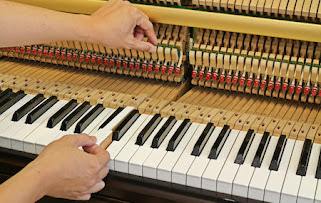
Grand Piano Regulation

For pianists, a grand piano is a majestic instrument capable of expressing a vast array of emotions. But that expressiveness hinges on one c...