Sunday, May 5, 2024

Grand Piano Regulation

For pianists, a grand piano is a majestic instrument capable of expressing a vast array of emotions. But that expressiveness hinges on one crucial aspect: regulation.

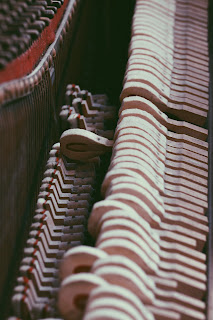
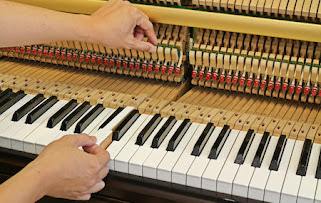
Grand piano regulation is the art of fine-tuning the action, the intricate mechanism that translates your keystrokes into sound. It's like meticulously adjusting the gears of a race car –  everything needs to be perfectly aligned for optimal performance.

Why Regulate?

Imagine a piano with sluggish keys or hammers that don't strike the strings evenly. The result? Unresponsive touch, uneven tone, and frustration for the pianist. Regular regulation ensures:

Even key touch: Every key should feel consistent, regardless of its position on the keyboard.

Responsive action: A well-regulated piano allows for effortless playing, enabling pianists to precisely control dynamics and articulation.

Optimal tone: Precise hammer strikes produce a clear, rich sound across the entire range of the instrument.

Long-term piano health: Regulation helps prevent unnecessary wear and tear on the action components, extending the life of your piano.

What Does Regulation Involve?

A piano technician with a keen eye and skilled hands performs regulation. Here's a glimpse into some of the adjustments made:

Key leveling: Ensuring all keys sit at the same height for a smooth playing experience.

Action adjustments: Fine-tuning parts like the let-off mechanism and damper timing for optimal responsiveness.

Hammer voicing: Shaping the felt on the hammers to achieve a desired tonal quality.

It's a Delicate Dance

Regulation is a multi-layered process that requires a deep understanding of piano mechanics and the ability to make minute adjustments. It's not just about following a checklist; a skilled technician uses their experience to tailor the regulation to the specific piano and the pianist's playing style.

Investing in the Magic

While piano regulation might seem like a technical mystery, it's an investment that significantly enhances your piano playing experience. A well-regulated grand piano becomes an extension of yourself, allowing you to express your musicality with freedom and finesse.

Considering having your grand piano regulated? Consult a qualified piano technician to bring out the full potential of your instrument and rediscover the joy of playing.

Get More Info : Grand Piano Regulation

Website : https://www.nypianoworks.com/

Contact Us : Piano Tuner Berkshires

Tuesday, April 30, 2024

Service your action today! | Piano Regulation New York


One of the most often performed and most necessary things one can do to a piano is to have the action serviced. The benefits, compared to the cost, result in great value and a noticeable improvement in the performance of your piano.

Action Servicing involves three procedures: Cleaning the action, tightening all screws, and lubricating action centers. The procedure takes about an hour.

Cleaning is the first step. The action is removed from the Piano , dust and debris are blown out with compressed air (outside of course), and the action is wiped down with cleaning solution and a microfiber cloth.

Next, we tighten all the screws. In an upright piano action, that’s well over 200 screws! We tighten hammer butt screws, whippen screws, action frame screws, and damper screws. In a grand action there are fewer screws: Action frame screws, Hammer flange screws, and whippen screws.

Finally, we lubricate the moving parts. Most pivot points in piano actions are comprised of pins that ride inside cloth bushings. The lubricant that we use clears out dust and debris, lubricates the pivot point, and protects it from future damage. In an upright Piano Repair, we lubricate hammer butt flanges, damper flanges, whippen flanges and jack flanges, as well as balance rail pins. In a grand piano we lubricate hammer flanges, whippen flanges, jack flanges, and balance rail pins.

Action servicing should be done every three to five years, depending on usage and environmental conditions. In addition to making the piano play more efficiently and with less extraneous noise, servicing the action also affords the technician an opportunity to examine each of the many moving parts, and correct minor problems before they become major and costly ones. Make an appointment today!

Get more info : PianoDisc Repair

Website : https://www.nypianoworks.com/

Contact Us : Piano Regulation And Voicing

Monday, April 22, 2024

Why It’s Important to Tune Your Piano | Grand Piano Regulation

There are around 230 strings on the average piano. Each string on the piano has a unique pitch and frequency that must be tuned to the other strings. The sound quality of your piano is determined by these strings, so they must be maintained properly. Due to stress, these strings can stretch over time, causing the piano to become out of tune. Seasonal Changes in humidity also cause the piano to become out of tune.

When pianos are tuned regularly, they are easier to tune, stay in good condition, and maintain their value. Piano tuning regularly also avoids damage caused by overstretched strings. It will be more expensive and time-consuming to get a piano back into tune if it hasn't been tuned in a long time.


If a piano hasn't been tuned in a long time, a piano tuner may attempt to correct the problem by raising the piano's pitch. This involves pulling all of the strings, resulting in a sharp pitch. When the strings naturally stretch over time, causing the pitch to go flat, this overcompensation should keep the piano in tune.

You should have your piano checked every six months to a year to ensure that the strings last as long as possible. If the strings are damaged too much or the keys are not properly working, you should take a piano repair service. 

Get More Info : Piano Humidity Control

Website : https://www.nypianoworks.com/

Contact Us : Piano Tuner Upstate New York

Tuesday, April 16, 2024

Rebuilding vs. Restoration | Piano Regulation And Voicing

Every week, I speak with at least a couple of people who are interested in not giving up on their older piano, but rather bringing it back to a playable condition. There are two ways to do this: Rebuilding and Restoration. Both attempt to restore the piano to its former glory, but the philosophy behind them differs.

Rebuilding can involve anything from an action overhaul to replacement of soundboard, strings, and pin block. Where possible, new parts are used. I say where possible because while the industry became standardized around the 1920s, pianos prior to that often have parts for which it is impossible to find replacements.

For example, we are doing a rebuild right now for a client in Albany, a piano from 1909. The hammer butts and hammer assemblies are able to be replaced, but the whippens (the mechanism which transfers the energy from the key to the hammer assembly) are non-standard and must be reconditioned by cleaning and by replacing leather and felt where possible. 


Get More Info :  Piano Regulation And Voicing

Website : https://www.nypianoworks.com/

Contact Us : Piano Tuner Upstate New York


Monday, April 8, 2024

Wessell, Nickel, and Gross Actions | Piano Master Technician

Scott is a trained Action Rebuilder specializing in the composite actions from Wessell, Nickel, and Gross. These are the same actions that are in every new Mason and Hamlin piano. Call to learn about the benefits of rebuilding your action with these state-of-the-art parts! 

The name “Wessell, Nickel & Gross” then lay dormant from 1953 to 2005, when two brothers—Kirk and Gary Burgett—acquired it. Just as Otto, Adam, and Rudolph had new thoughts and ideas to improve the piano action in their time, so too did Kirk and Gary.

Perhaps the most radical of these ideas came from the fundamental question, “100 years ago piano actions were made of wood, since that was one of the best materials available at the time. Could we use the latest advances in materials science to design and create a better piano action?”

This question spurred research into modern materials such as composites and epoxy carbon fiber. The benefits of these modern materials became almost immediately clear—composites had the potential to be much stronger than wood, they could be easily customized and formed to much tighter tolerances, and they were extremely durable so their finished shape wouldn’t change over time. Before long, the advantages becameso numerous that it was obvious that composite materials had the potential to change piano actions forever.

Get More Info : Wessell Nickel and Gross

Website : https://www.nypianoworks.com/

Contact Us : Piano Tuner Upstate New York

Monday, April 1, 2024

PianoDisc Player System Installation and Repair | PianoDisc Repair

In the realm of musical innovation, where tradition meets technology, the PianoDisc player system emerges as a transformative addition to the world of pianos. Offering the enchantment of live performances at the touch of a button, this sophisticated system breathes new life into classical instruments. However, like any mechanical marvel, maintenance and repair are essential to ensure its continued harmony. In this blog post, we delve into the intricacies of PianoDisc player system installation and repair, exploring how it elevates the piano-playing experience.


1. The Symphony of PianoDisc: A Harmonious Fusion

a. Bridging Tradition and Technology:

Introduce readers to the PianoDisc player system, highlighting its role in seamlessly blending the timeless elegance of acoustic pianos with modern digital capabilities.

b. Musical Versatility:

Explore the versatility of the PianoDisc system, from classical compositions to contemporary tunes. Emphasize its ability to cater to diverse musical preferences with its vast library of performances.

2. PianoDisc Installation: Crafting Musical Magic

a. Precision Engineering:

Discuss the meticulous process of installing a PianoDisc player system. Cover the integration of sensors, solenoids, and control units, ensuring flawless synchronization between the piano and the digital components.

b. Customization Options:

Highlight the customizable features available during installation, such as playback modes, volume control, and compatibility with external devices. Illustrate how these options cater to the preferences of both pianists and listeners.

Get More Info : PianoDisc Repair

Website : https://www.nypianoworks.com/

Contact Us : Piano Tuner Berkshires

Thursday, March 28, 2024

Humidity Control for your Piano | Piano Finish Repair

Many people are not aware that humidity can have a profound effect on the tuning and performance of your piano. Humidity is a measure of how much water vapor is in the air, relative to the maximum amount of water vapor it can hold (that’s why it’s called relative humidity!).  Your piano is subject to wide swings in humidity. This is parrly true in, while in the winter, your heating system can drop the relative humidity in your home into the single digits.


What does this mean for your piano? When the humidity is high, the soundboard and bridges absorb moisture and swell, increasing the tension of the strings and forcing the piano sharp. When the humidity is low, the opposite happens - the soundboard and bridges release moisture and shrink, reducing the downward pressure of the strings and forcing the piano flat. This is why almost all piano manufacturers - and your piano technician - recommend that your piano is tuned twice a year. In addition to forcing your piano out of tune, increased humidity affects the action parts, swelling the wood and increasing friction, which can make your action respond sluggishly (a major cause of “sticking” keys).

How can you mitigate the effects of humidity on your piano? There are several options. The absolute best solution is to have your whole house humidity controlled. This involves either attaching a humidifier to your HVAC system or installing a separate humidifier/dehumidifier system in your home. While this is the best solution, it can be very expensive to install and maintain, and is usually cost prohibitive.

The next, and we think best, solution is to install a humidity control system directly in your piano. The Dampp Chaser company, makers of the Piano Life Saver system, is the only company making these systems. Over the past 74 years they have perfected their system and adapted it to work in all pianos. This system maintains the relative humidity of your piano within a few percent of the ideal level of 45% Relative Humidity. A humidistat regulates the humidity, similar to the way your thermostat regulates temperature. If the humidity is high, the humidistat activates low power dehumidifier bars to dry out the piano. If the humidity is low, the humidistat activates a humidifier - a gentle version of that which you might put in a room. Periodically, you must fill the humidifier tank with water. This can be disconcerting the first few times, pouring water into a tube that disappears into your piano!


Get More Info : Piano Rebuilding Upstate New York

Website : https://www.newyorkpi anoworks.com/

Contact Us : Grand Piano Repair

Thursday, March 21, 2024

Why It’s Important to Tune Your Piano

 There are around 230 strings on the average piano. Each string on the piano has a unique pitch and frequency that must be tuned to the other strings. The sound quality of your piano is determined by these strings, so they must be maintained properly. Due to stress, these strings can stretch over time, causing the piano to become out of tune. Seasonal Changes in humidity also cause the piano to become out of tune.

When pianos are tuned regularly, they are easier to tune, stay in good condition, and maintain their value. Piano tuning regularly also avoids damage caused by overstretched strings. It will be more expensive and time-consuming to get a piano back into tune if it hasn’t been tuned in a long time.

If a piano hasn’t been tuned in a long time, a piano tuner may attempt to correct the problem by raising the piano’s pitch. This involves pulling all of the strings, resulting in a sharp pitch. When the strings naturally stretch over time, causing the pitch to go flat, this overcompensation should keep the piano in tune.

You should have your piano checked every six months to a year to ensure that the strings last as long as possible. If the strings are damaged too much or the keys are not properly working, you should take a piano repair service.

If you buy a new piano, you should tune it four times in the first year since the new strings stretch more and go out of tune more quickly. If you tune your piano regularly throughout the first few years of ownership, it will be more likely to stay in tune for longer periods of time and during the later years of its life.

Regular piano tuning can increase confidence in people beginning to play the piano, as it’s exciting to play piano that’s in tune and sounds nice. Standard tuning is for those pianos that have been tuned in the past 6 months to a year. It involves manipulating the tuning pins to bring all the strings to their proper and harmonious pitch. We use a combination of aural and electronic tuning to ensure your piano sounds great!

If you want to tune your piano, book your appointment today!

Visit Us : Piano Tuning And Repair Service Upstate New York.

Tuesday, March 19, 2024

Free Pianos Aren’t Free — Al Tervenski

 Many of us have been in this situation before. A friend, family member, or acquaintance has a free piano. Free piano! All you have to do is move it, they say. Or maybe you’ve recently moved into a new home that “includes” a piano. If these situations seem too good to be true, it’s because they often are. Pianos are like anything else in the marketplace. Some are worth thousands upon thousands of dollars, and some are absf you moved into a house with a piano sitting sadly in the living room, the previous owners figured it wasn’t worth the $400 to move it. Why should you be stuck with it? Free pianos are often not worth taking. After moving it for $300-$400, and then pitch-raising and tuning it ($300), you’re in for $700 already! Now factor in regulation and repairs, and you’re well over $1000 invested into a piano that won’t last and won’t sound good. A piano your son or daughter won’t want to play, and

one that will just sit and collect dust.

This is not to say that sometimes a free piano isn’t a good deal. Lucky bargains do happen upon us occasionally. But how will you know if you have a lemon or a steal? Bring a piano technician with you to help assess the piano (we’re happy to help). More likely than not, you’d be better off paying for one. For as little as $500-$1000, you can obtain a solid beginner piano that will provide you with years of enjoyment. We have pianos in stock at New York Piano Works that fit this description. They are affordable, play well, and are worth the modest investment. Or, you can take a chance on a “free” craigslist or Facebook Marketplace piano. Just remember, free pianos aren’t free.

Read More : Piano Tuning And Repair Service Upstate New York.

Visit Us : Piano Rebuilding Upstate New York.

Thursday, March 14, 2024

Rebuilding vs. Restoration- nypianoworks


Every week, I speak with at least a couple of people who are interested in not giving up on their older piano, but rather bringing it back to a playable condition. There are two ways to do this: Rebuilding and Restoration. Both attempt to restore the piano to its former glory, but the philosophy behind them differs.

Rebuilding can involve anything from an action overhaul to replacement of soundboard, strings, and pin block. Where possible, new parts are used. I say where possible because while the industry became standardized around the 1920s, pianos prior to that often have parts for which it is impossible to find replacements.

For example, we are doing a rebuild right now for a client in Albany, a piano from 1909. The hammer butts and hammer assemblies are able to be replaced, but the whippens (the mechanism which transfers the energy from the key to the hammer assembly) are non-standard and must be reconditioned by cleaning and by replacing leather and felt where possible.

Rebuilding often gives the best musical results, as newer parts are often superior. However, some people want their piano as true to the original as possible. That is where restoration comes in.

Restoration seeks to use the original parts and historically accurate materials. This will reproduce, as closely as possible, the aesthetic of the time in which the piano was built. This route is most often reserved for pianos which have great historical or sentimental value. It is often cheaper to replace parts than it is to recondition them, as reconditioning is extremely labor-intensive. Thus, the cost of historical restoration of a piano can exceed that of rebuilding by a fair amount.

Whether you are interested in rebuilding or restoring your piano, New York Piano Works is the primer facility for Upstate New York and the entire Hudson Valley. Make an appointment to have your piano evaluated today!

Visit Us : www.newyorkpianoworks.com

Wednesday, March 13, 2024

Basics of Piano Care

 FIRST POST! Thanks for checking out this blog page. We will be adding content every week or so, as long as we keep coming up with interesting and informative things to say.

I’d like to start by talking about basic piano care… The aspect of piano care that everyone is familiar with is tuning. Pianos go out of tune due to changes in humidity, which swells and shrinks the wood of the soundboard, bridges, and action parts. This happens regardless of how much or how little the piano is played. We STRONGLY recommend having your piano tuned twice a year. This is in line with all manufacturer’s recommendations. If you put it in terms of car maintenance (the other big, complicated machine in your life), tunings are the oil changes of piano care. It’s important to note that your piano may be out of tune and still sound relatively ok, but not be at the correct pitch. More on this in a future post. Is your piano out of tune? Find out how to determine this here.

A piano is a very complex instrument, with up to 10,000 parts — many of which move and are subject to wear over time. This causes the piano to function at a sub-optimal level, lessening your enjoyment and making playing and learning more difficult. The good news is this is a relatively easy condition to combat. Every 3 years or so, the action should be serviced. To do this, we remove the action, clean it with compressed air, lubricate all action centers, and tighten all screws (over 200 in uprights!). This serves three purposes: it makes the piano play better, avoids problems due to contaminant buildup, and allows for the detection of small issues before they become big ones. If it were a car, this would be the inspection and basic tune up.

As the piano ages, the parts deteriorate. Felt gets compressed, screws loosen, and gravity acts on the hammers. The result is poor performance — lack of dynamic range, the inability to play softly, and unevenness of touch. The solution to this is regulation. Regulation is the adjusting of numerous measurements and tolerances for each note, bringing the piano back to a level of playability it enjoyed when leaving the factory (or better). This takes several hours, but it is a normal and necessary part of caring for your instrument. In car terms, it’s like having the transmission serviced, and alignment done, and a thorough tune up — like a 50,000 mile service. This should be done every 5 years or so, but can also be done piecemeal at your six month appointments to spread out the expense. Vertical Regulation is explained in greater detail here, and Grand Regulation can be found here.

Visit Us : Piano Restoration Upstate New York.

Contact Us : Grand Piano Repair.

Thursday, March 7, 2024

Basics of Piano Care | Piano Rebuilding Hudson Valley

FIRST POST! Thanks for checking out this blog page. We will be adding content every week or so, as long as we keep coming up with interesting and informative things to say.


I’d like to start by talking about basic piano care… The aspect of piano care that everyone is familiar with is tuning. Pianos go out of tune due to changes in humidity, which swells and shrinks the wood of the soundboard, bridges, and action parts. This happens regardless of how much or how little the piano is played. We STRONGLY recommend having your piano tuned twice a year. This is in line with all manufacturer’s recommendations. If you put it in terms of car maintenance (the other big, complicated machine in your life), tunings are the oil changes of piano care. It’s important to note that your piano may be out of tune and still sound relatively ok, but not be at the correct pitch. More on this in a future post. Is your piano out of tune? Find out how to determine this here.

A piano is a very complex instrument, with up to 10,000 parts - many of which move and are subject to wear over time. This causes the piano to function at a sub-optimal level, lessening your enjoyment and making playing and learning more difficult. The good news is this is a relatively easy condition to combat. Every 3 years or so, the action should be serviced. To do this, we remove the action, clean it with compressed air, lubricate all action centers, and tighten all screws (over 200 in uprights!). This serves three purposes: it makes the piano play better, avoids problems due to contaminant buildup, and allows for the detection of small issues before they become big ones. If it were a car, this would be the inspection and basic tune up.

Get more Info : Piano Restoration

Website : https://www.newyorkpianoworks.com/

Contact us : Piano Rebuilding Hudson Valley

Piano Tuning And Repair Service Hudson Valley , Piano Tuning And Repair Service Upstate New York , Grand Piano Regulation , Piano Tuner Upstate New York


Thursday, February 29, 2024

Piano Rebuilding Albany | Rebuilding / Restoration

Pianos age like all machines, and their parts wear out over time. While a quality piano will outlast most other things in your life, at some point the strings will cease to be responsive and the action parts will have irreparable wear. At this point, a partial or full rebuilding is required. New York Piano Works will come to your house and provide you with a written estimate for this complicated procedure.

Restoration is bringing the piano back to its original condition by reconditioning original parts and using historically accurate replacements where applicable. It is generally more expensive than rebuilding but keeps the piano true to its origins. 

Get More Info : Grand Piano Regulation

Website : https://www.nypianoworks.com/

Contact Us : Piano Tuner Berkshires

Tuesday, February 20, 2024

PianoDisc Player System Installation and Repair

 Imagine controlling your piano with your iPad or phone! PianoDisc is on the cutting edge of player piano technology. Whether you have an existing system that needs repair or upgrading, or would like a system installed in your piano, New York Piano Works can help. Scott is a Certified Installer of these systems.

Your piano is affected by the large swings in humidity that we have in the area. A Dampp-Chaser system from Piano Life Saver will keep your piano at a relative humidity of 45% +- 5% all year round. This will protect your soundboard from cracks and compression ridges, and stabilize your piano so it stays better in tune between appointments. All of us at New York Piano Works are Certified Installers.

Visit Us : Piano Tuning And Repair Service Hudson Valley.

Contact Us : Piano Restoration Upstate New York.

Sunday, February 18, 2024

Why It’s Important to Tune Your Piano

 There are around 230 strings on the average piano. Each string on the piano has a unique pitch and frequency that must be tuned to the other strings. The sound quality of your piano is determined by these strings, so they must be maintained properly. Due to stress, these strings can stretch over time, causing the piano to become out of tune. Seasonal Changes in humidity also cause the piano to become out of tune.

When pianos are tuned regularly, they are easier to tune, stay in good condition, and maintain their value. Piano tuning regularly also avoids damage caused by overstretched strings. It will be more expensive and time-consuming to get a piano back into tune if it hasn’t been tuned in a long time.

If a piano hasn’t been tuned in a long time, a piano tuner may attempt to correct the problem by raising the piano’s pitch. This involves pulling all of the strings, resulting in a sharp pitch. When the strings naturally stretch over time, causing the pitch to go flat, this overcompensation should keep the piano in tune.

You should have your piano checked every six months to a year to ensure that the strings last as long as possible. If the strings are damaged too much or the keys are not properly working, you should take a piano repair service.

If you buy a new piano, you should tune it four times in the first year since the new strings stretch more and go out of tune more quickly. If you tune your piano regularly throughout the first few years of ownership, it will be more likely to stay in tune for longer periods of time and during the later years of its life.

Regular piano tuning can increase confidence in people beginning to play the piano, as it’s exciting to play piano that’s in tune and sounds nice. Standard tuning is for those pianos that have been tuned in the past 6 months to a year. It involves manipulating the tuning pins to bring all the strings to their proper and harmonious pitch. We use a combination of aural and electronic tuning to ensure your piano sounds great!

If you want to tune your piano, book your appointment today!

Read More : Piano Tuning And Repair Service Hudson Valley.

Visit Us : Piano Tuner Upstate New York.

Contact Us : Piano Humidity Control.

Wednesday, February 14, 2024

PianoDisc Player System Installation and Repair | PianoDisc Repair

If you're looking for blog content related to PianoDisc player system installation and repair, there are several topics you could cover. Here are some ideas to get you started:

Introduction to PianoDisc Player Systems: Explain what PianoDisc player systems are, how they work, and their benefits for piano enthusiasts.

Installation Guide for PianoDisc Player Systems: Provide a step-by-step guide on how to install a PianoDisc player system onto a piano. Include tips, recommended tools, and potential challenges to watch out for.

Troubleshooting Common Issues: Create a blog post that addresses common problems that PianoDisc owners may encounter, such as issues with playback quality, connectivity problems, or software glitches. Provide troubleshooting steps and solutions for each problem.

Maintenance Tips: Offer advice on how to properly maintain a PianoDisc player system to ensure optimal performance and longevity. This could include tips on cleaning, regular inspections, and preventative maintenance.

Upgrading Your PianoDisc System: Discuss the process of upgrading an existing PianoDisc system to take advantage of new features or technologies. Provide guidance on compatibility, cost considerations, and installation procedures.

Customer Success Stories: Share testimonials or case studies from satisfied PianoDisc customers who have had successful installations or repairs. This can help build trust and credibility with potential customers.

Comparison Guides: Compare PianoDisc player systems with other similar products on the market, highlighting their unique features, advantages, and drawbacks.

Interviews with Experts: Conduct interviews with experts in the field of piano technology or PianoDisc systems to provide insights and advice to your readers.

Remember to tailor your content to your target audience and their level of expertise. Whether you're addressing beginners who are new to PianoDisc systems or experienced piano technicians looking for advanced repair tips, providing valuable and informative content will help establish your blog as a trusted resource in the piano community.

Get More Info : PianoDisc Repair

Website : https://www.nypianoworks.com/

Contact Us : Piano Tuner Upstate New York


Monday, February 12, 2024

Wessell, Nickel, and Gross Actions

It sounds like you're referring to Wessell, Nickel, and Gross (WNG), a company known for their actions, particularly in the context of blog content. However, it seems there might be a misunderstanding as I'm not aware of any direct correlation between blog content and Wessell, Nickel, and Gross.

Could you please provide more context or clarify your request? Are you looking for information on Wessell, Nickel, and Gross's actions in a specific context, or are you looking for assistance with blog content related to them or any actions they may have taken? Any additional details you can provide would be helpful in understanding how to assist you better.

Get More Info : Wessell Nickel and Gross

Website : https://www.nypianoworks.com/

Contact Us : Piano Tuner Upstate New York

Monday, February 5, 2024

Basics of Piano Care | Grand Piano Regulation

FIRST POST! Thanks for checking out this blog page. We will be adding content every week or so, as long as we keep coming up with interesting and informative things to say.

I’d like to start by talking about basic piano care… The aspect of piano care that everyone is familiar with is tuning. Pianos go out of tune due to changes in humidity, which swells and shrinks the wood of the soundboard, bridges, and action parts. This happens regardless of how much or how little the piano is played. We STRONGLY recommend having your piano tuned twice a year. This is in line with all manufacturer’s recommendations. If you put it in terms of car maintenance (the other big, complicated machine in your life), tunings are the oil changes of piano care. It’s important to note that your piano may be out of tune and still sound relatively ok, but not be at the correct pitch. More on this in a future post. Is your piano out of tune? Find out how to determine this here.

A piano is a very complex instrument, with up to 10,000 parts - many of which move and are subject to wear over time. This causes the piano to function at a sub-optimal level, lessening your enjoyment and making playing and learning more difficult. The good news is this is a relatively easy condition to combat. Every 3 years or so, the action should be serviced. To do this, we remove the action, clean it with compressed air, lubricate all action centers, and tighten all screws (over 200 in uprights!). This serves three purposes: it makes the piano play better, avoids problems due to contaminant buildup, and allows for the detection of small issues before they become big ones. If it were a car, this would be the inspection and basic tune up.

Get More Info : Piano Restoration

Website : https://www.nypianoworks.com/

Contact Us : Piano Tuner Hudson Valley

Tuesday, January 30, 2024

Humidity Control for your Piano | Historical Keyboards

Many people are not aware that humidity can have a profound effect on the tuning and performance of your piano. Humidity is a measure of how much water vapor is in the air, relative to the maximum amount of water vapor it can hold (that’s why it’s called relative humidity!).  Your piano is subject to wide swings in humidity. This is particularly true in the Hudson Valley, where the majority of our clients live. In the summer, humidity levels can go as high as 100%, while in the winter, your heating system can drop the relative humidity in your home into the single digits.

What does this mean for your piano? When the humidity is high, the soundboard and bridges absorb moisture and swell, increasing the tension of the strings and forcing the piano sharp. When the humidity is low, the opposite happens - the soundboard and bridges release moisture and shrink, reducing the downward pressure of the strings and forcing the piano flat. This is why almost all piano manufacturers - and your piano technician - recommend that your piano is tuned twice a year. In addition to forcing your piano out of tune, increased humidity affects the action parts, swelling the wood and increasing friction, which can make your action respond sluggishly (a major cause of “sticking” keys).

How can you mitigate the effects of humidity on your piano? There are several options. The absolute best solution is to have your whole house humidity controlled. This involves either attaching a humidifier to your HVAC system or installing a separate humidifier/dehumidifier system in your home. While this is the best solution, it can be very expensive to install and maintain, and is usually cost prohibitive. 

Get More Info : Piano Restoration

Website : https://www.nypianoworks.com/

Contact Us : Piano Tuner Upstate New York

Tuesday, January 23, 2024

Rebuilding vs. Restoration

Every week, I speak with at least a couple of people who are interested in not giving up on their older piano, but rather bringing it back to a playable condition. There are two ways to do this: Rebuilding and Restoration. Both attempt to restore the piano to its former glory, but the philosophy behind them differs.

Rebuilding can involve anything from an action overhaul to replacement of soundboard, strings, and pin block. Where possible, new parts are used. I say where possible because while the industry became standardized around the 1920s, pianos prior to that often have parts for which it is impossible to find replacements.

For example, we are doing a rebuild right now for a client in Albany, a piano from 1909. The hammer butts and hammer assemblies are able to be replaced, but the whippens (the mechanism which transfers the energy from the key to the hammer assembly) are non-standard and must be reconditioned by cleaning and by replacing leather and felt where possible. 

Get More Info : Piano Restoration

Website : https://www.nypianoworks.com/

Contact Us : Piano Restoration Upstate New York

Grand Piano Regulation

For pianists, a grand piano is a majestic instrument capable of expressing a vast array of emotions. But that expressiveness hinges on one c...